"X" MARKS THE SPOT
Early Variations of X - Bracing
C. F. Martin 1840's Spanish Size 1, Style 28
This Martin has what could likely be the first variation of X-bracing, which appears at about the same time on a handful of Martin, Martin & Coupa, and Schmidt & Maul Guitars, in the 1840's. Schmidt & Maul guitars with this bracing pattern have been seen dated 1845 and 1848.
Martin & Coupa Alternate X Brace Spanish Guitar
Schmidt & Maul
Schmidt and Maul were early employees of C.F. Martin in New York, and later appeared at the same address as one of Martin's distributors. Schmidt & Maul made guitars very similar to Martin's in New York after Martin moved to Cherry Hill, Pennsylvania in 1839.
This Schmidt and Maul, dated 1847, has another early variation of X bracing.
This top photo shows a fan coming from the soundhole.
The second photo shows an X, at the bride plate end, on the treble side.
And this third photo shows the brace crossing the center from the treble side only.
On this 1840's Spanish Martin guitar the tone bar below the bridge plate extends across the treble side of the X forming a second smaller X, in a similar way as the Schmidt & Maul above has a tone bar which crosses the treble blade of the fan.
It should be noted that variations appear which are based on the fan, while other variations are based on a large X.
These are the variations of X bracing we now know of:
-the half fan/half X on the Lark St. 1845 Schmidt & Maul and on the hybrid-X Martin above.
-the fan with a tone bar below the bridge plate crossing the treble blade of the fan forming a small X on the treble side on this 1847 Schmidt & Maul.
-A large X brace with the tone bar below the bridge plate crossing the treble side of the X to form a second smaller X.
-the double X on Fred Oster's Martin illustrated in the new Longworth.
-the diamond around the bridge plate on the Martin that appeared on the Martin Guitar Forum
None of the Martins are dated, so we still don't know who did which X first.
Scalloped and Tapered Braces
I remember first hearing about pre-war Martins, and how they had "scalloped" braces that were different from the contemporary "straight" braces, in that they were contoured to make them lighter weight. Only relatively recently has it become common knowledge that the first "straight" braces made after the transition from scalloped braces in 1945 were actually tapered, which made them lighter than later straight braces.
Noticing that 1945 Martins have a wonderful, distinct, punchy sound, I've investigated further, and discovered that the tapered braces in 1945 were unique, having a slimmer taper than in the years until tapered braces were phased out in the late forties, giving these guitars their distinctive sound.
Tapered Martin Braces in 1945
1945 D-18

Tapered Martin Braces in 1946, which are much rounder than in 1945.
1946 000-18
In mid-1939 Martin shifted the position of the intersection of the X on 000 size guitars and Dreadnaughts from roughly one inch below the edge of the soundhole to roughly 1 3/4" back, in a move known as "Forward X" or "High X" to "Rear X" bracing, to make the top more stable. Some players prefer the sound of the earlier version, which makes these guitars highly sought after, while some believe the later version is easier to "mic".
The position of the braces on 14 fret 00 Martins changed in 1935. 12 fret Martins did not change.
In roughly 1958, the bracing of Dreadnaughts changed again, from back shifted X to slightly less backshifted X with a wider cross angle.
Note that in mid-1939, most Martins added a "popsicle brace" at the same time the upper transverse brace was increased from 5/16" to 1/2" in width.
These changes appear to have occurred at the same time the neck width changed from 1 3/4" to 1 11/16" and neck block on dreadnaughts changed from 1 9/16" to 1 5/16" in thickness.
1931 or 1932:
1"-wide trapezoidal to 1 3/8"-wide hexagonal bridgeplates
Mid 1935:
Forward shifted to rear shifted braces on 12 fret 00 Martins
Mid 1938:
Forward shifted to rear shifted braces on 000 and Dreadnaught Martins
Mid 1939:
1 3/4" to 1 11/16" neck
Popsicle brace added
5/16" wide to 1/2" wide upper transverse brace (UTB)
1 9/16" to 1 5/16" thick neck block on dreadnoughts, to match small bodied Martins.
1940 or 1941:
1 3/8" wide hexagonal to 1 3/8"-wide trapezoidal bridgeplates
1945:
Scalloped to tapered braces
1958:
Back shifted X to slightly less backshifted X with a wider cross angle
Bracing Diagrams
Early Martin Bracing Diagrams
Martin braces evolved from the ladder bracing used on the Viennese guitars Martin learned to build before coming to the US, to the fan bracing learned from Spanish guitars, to several variants of X bracing before settling on the matureX pattern still used today.
Interestingly, both Martin and Schmidt & Maul, former Martin employees, worked in parallel, building guitars with the exact same variations. It is unknown whether the tho firms collaborated or competed, or if one copied the other.
Here is a diagram for the Stauffer Style Martin, the earliest known Martin c. 1833.
Martin's earliest guitars had ladder bracing.
Martin c. 1833 Stauffer Style
And here is a diagram for a very early Spanish Style Martin & Coupa, from the 1840's, with fan braces:
Martin & Coupa 1840's Spanish Style
This Spanish Schmidt & Maul from the 1840's is nearly identical to the Spanish Martin & Coupa with fan bracing.
Schmidt & Maul 1840's Spanish Style:
This early Martin and Coupa shows what I call "Hybrid X" bracing, essentially an early combination of fan bracing and X bracing:
Martin & Coupa c. 1845 "Hybrid X"
This early Martin 1-28 from the mid-1840's shows the exact same "Hybrid X" bracing as the Martin & Coupa, a variation also seen in Schmidt &Maul from the period.
Martin 1-28 c. 1845 "Hybrid X"
This 1840's Martin shows another early variant of X bracing, with the tone bar extending across the X brace to form a second smaller X on the treble side.
This 1840's Schmidt & Maul has a variant of X bracing with a similar concept, with a tone bar extending across one fan of the fan bracing to form another smaller X on the treble side.
Here we see a circa 1845 Martin with mature X bracing, an exampled believed to be possibly the earliest known example.
12 and 14 Fret Bracing Diagrams
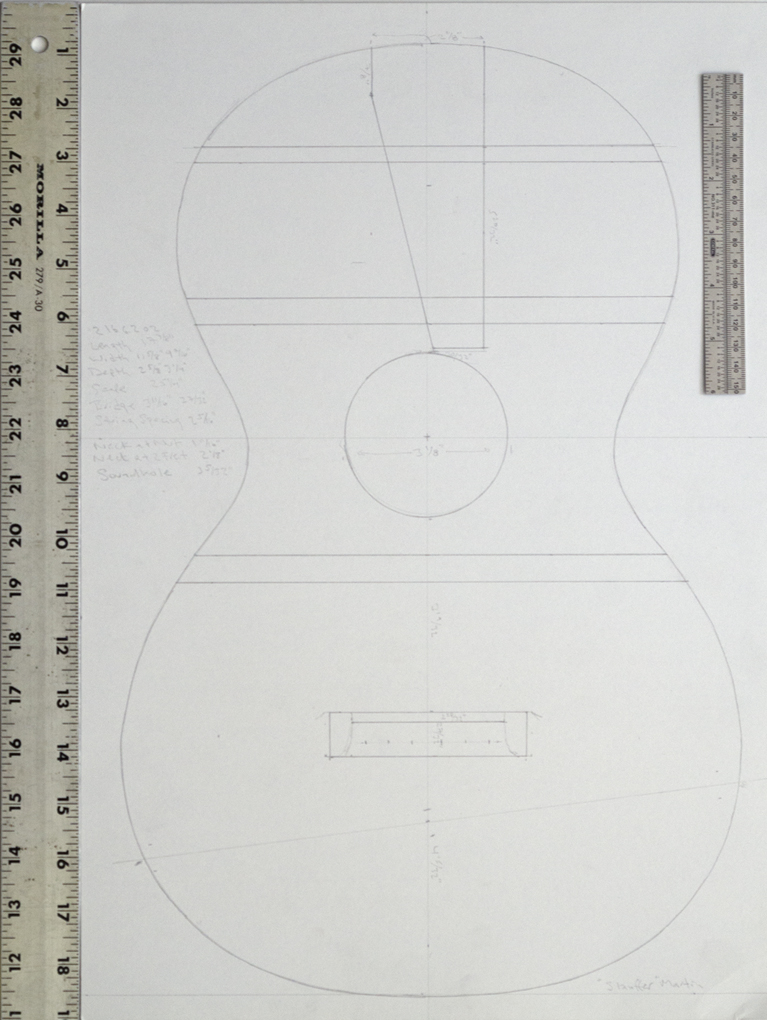
These bracing diagrams should help to illustrate the development of the 14 fret Martin.
You can see here the difference between the 1928 and 1928 "forward shifted X-braces", and the X braces on the 1944 which have been moved further back, a change which happened in 1938 on Martin Dreadnaughts.
Click on the diagram to download a full size 1:1 diagram.
1929 000-28
1930 OM-28
The upper outline at the top shows the shape of the upper bout on a 1933 OM-28, illustrating the smaller, rounder upper bout of the early original OM-28.
1944 000-18
earlymartin.com
To See Robert Corwin's Classic Photography of Folk and Roots Musicians, visit:
For Information on Photography for
Exhibition, Publication, CD's, Promotion, Web Pages, Tour Books,
to Purchase Photographic Prints, or
If You Have Questions About An Early Martin Guitar:
e-mail: Robert Corwinentire site copyright ©1998 through 2013 Robert Corwin/Photo-Arts. All rights reserved.